

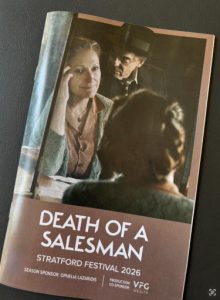
Death Of A Salesman at the Stratford Festival
Starting off with an ear-piercing trumpet solo, Stratford’s Death of a Salesman at the Avon Theatre may be the loudest production on record. Director Dean Gabourie has given us a Salesman full of sound and fury signifying . . . well what exactly?
Death of a Salesman is often seen as a devastating critique of the so-called American Dream, in which all it takes to get ahead is good looks, a winning smile, and being well-liked. Miller himself likened it to a Greek tragedy. In a programme note, Gabourie tells us he sees it as “a heartbreaking portrait of a deeply dysfunctional – yet profoundly loving – family.”
Fair enough but I couldn’t help feeling that what is arguably Miller’s greatest achievement should be accorded something more than the kitchen sink drama shout-a-thon that Gabourie has conjured up.
Death of a Salesman tells the story of traveling salesman Willy Loman (Tom McCamus) and his long-suffering and fiercely loyal wife, Linda (Lucy Peacock). Their now adult sons have returned to the family home for an uncomfortable reunion. Biff (Joe Perry) has been out West for a number of years, drifting from job to job and occasionally incommunicado. His kid brother Hap (Josh Johnston), a striver in the world of retail and an incorrigible womanizer, has his own apartment but has returned for old times’ sake.
The crux of the play is Willy’s parlous relationship with Biff, who seems consumed with inchoate anger toward what he sees as his father’s inability to see that his son is a nobody who not only hasn’t made good but who probably never will.
Death of a Salesman is, in part at least, a memory play. Scenes from the the past of Willy, the boys, and Willy’s successful uncle Ben, now long dead, spring up and then fade away. It’s never quite clear whether these memories are accurate, something with which every production must come to grips.
My reservations abut this Death of a Salesman begin with Gabourie’s choice to mount the play on a bare stage surrounded by multi-storied, dark blocks of flats (sets by Scott Penner). This despite the fact that the Lomans live in a two-story house with a back yard.
Most productions I have seen at least sketch in this architecture, allowing the audience to watch Biff and Hap eavesdrop on the arguments flaring below. Gabourie has cast members carry white-painted wooden tables and chairs on and off to represent – sort of – the variety of settings Miller’s text calls for. It’s distracting at best and confusing at worst as the memory pieces are often muddled.
Gabourie has chosen to have his cast operate at full-throttle which has a way of drowning out the deeper resonances in Miller’s text. It made me wonder if those themes had ever been fully explored in rehearsal.
There’s a great deal of shouting in this Salesman, mostly from Biff and Willy. Linda tells us that Willy is exhausted, but Gabourie seems to have encouraged McCamus to operate at full tilt, filled with manic energy even when he’s supposed to be spent.
Perhaps it’s because I am seeing the ravages brought on by late life among those in my own age cohort, but I have never been more aware that Willy Loman is less the downtrodden product of American capitalism than yet another victim of senile dementia. Gabourie’s Death of a Salesman struck me more as a clinical study than a tragedy in the classical sense.
This being a Stratford production, the cast is good, often better than good. They all seem to be given exactly the performances Gabourie wanted to draw out of them, but only Peacock’s Linda struck me as coming close to the character Miller envisioned.
McCamus’s Willy is a bundle of nervous energy and I wished I had detected more shadings as he transitioned from past to present. Perry is a powerhouse, but the vehemence of his performance made me wonder, for the first time, why Biff doesn’t throw Willy’s adultery in his face in his present-day anger.
The craggily handsome David W. Keely, who towers over McCamus, made for an intriguing choice as the mysterious Ben; did he really walk into the jungle at nineteen and walk out at twenty-one a rich man?
The period costumes by Denyse Karn were spot on, the lighting by Louise Guinand was more than serviceable, and John Gzowski did some interesting things with the sound design. I couldn’t tell if the show was mic’ed, but with the lung power of this cast it certainly didn’t need to be.
I really wanted to admire this production of Death of a Salesman, but at the end, like Linda Loman, I couldn’t cry.
That said, Miller devotees will certainly want to see how McCamus and Peacock handle these iconic roles since, as always, your kilometrage may vary.
Death Of A Salesman continues at the Stratford Festival’s Avon Theatre through October 24, 2026. For more information and to purchase tickets visit the Stratford Festival website.
For a complete index of reviews CLICK HERE.
Don’t miss another review or blog post! SUBSCRIBE HERE
