

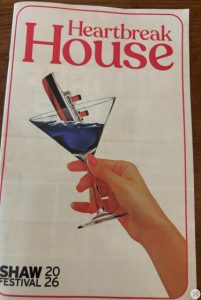
Heartbreak House At The Shaw Festival
Tim Carroll’s production of George Bernard Shaw’s Heartbreak House boasts a stellar cast. Why then does it fall so flat?
A major reason, I think, is that a very important character is missing – Heartbreak House. Not the play but the physical location. Shaw describes the set for the opening scene as having “been built so as to resemble the after part of an old-fashioned high-pooped ship.”
A proper set for Heartbreak House would tell us that Shaw’s characters are, in a sense, living in a fantasy world, that here they have set themselves apart from the real world to live out their fantasy of being, in the words of one character, “very charming people, most advanced, unprejudiced, frank, humane, unconventional, democratic, free-thinking, and everything that is delightful to thoughtful people.”
But it’s now the 1920s and the world in which these clueless toffs think they live has been shattered forever by the Great War.
Heartbreak House cries out to be staged in the Festival Theatre with all the theatrical magic a major theatre company can bring to bear. The place is, after all, called the Shaw Festival!
Instead, this major work of the Festival’s namesake has been relegated to the tiny Jackie Maxwell Studio Theatre and given a set that is really no set at all. Ximena Pinilla gives us a wooden floor with a pattern of brown diamonds and a brace of cheap-looking wooden chairs that keep getting moved about.
To give Pinilla her due, this is clearly the set the director wanted. She does much better with her costumes. Working with a palette of black and white, she has created some smashing 1920s period outfits for the women and this svelte ensemble wears them with panache.
But I’m getting ahead of myself. Heartbreak House premiered in 1920 in New York. I confess that I often tend to think of Shaw as a nineteenth century playwright, but this is very much a twentieth century work, reflecting Shaw’s disillusionment with England’s so-called upper classes in the wake of World War I.
The play takes place in the country home of 80-something Captain Shotover (Tom Rooney), a charming old curmudgeon who has sailed the seven seas and who, so rumour has it, sold his soul to the devil in Zanzibar. His daughter, Hesione Hushabye (Julia Course), who is married to the handsome but otherwise rather useless Hector Hushabye (Martin Happer), has invited her friend Ellie Dunn (Allison Edwards-Crewe) and her father (Neil Barclay) for a visit.
Hesione hopes to convince Ellie, who has no independent means of her own, to break off her engagement to “Boss” Mangan (Graeme Somerville), a rapacious business man and another invitee.
Returning after an absence of twenty-three years is Captain Shotover’s other daughter, Ariadne (Sochi Fried), now Lady Utterword, whose husband has been “governor of all the crown colonies in succession.” She is followed by her brother-in-law, Randall Utterword (Jason Cadieux) who is hopelessly in love with her.
On one level Heartbreak House is a dark romantic comedy, underline the heartbreak, in which no one gets quite what they want. The sisters Shotover seem to exert an irresistible allure for every man who falls within their orbit. While there is never a hint of real impropriety, they clearly enjoy wielding their feminine wiles on their hapless victims.
Shaw subtitled Heartbreak House a “Fantasia in the Russian Manner on English Themes.” The reference to Chekhov was intentional. In his preface to the play, Shaw specifically mentions The Cherry Orchard, another work about the inability of the upper orders to adapt to a changing world.
Heartbreak House, then, should be a comedy. If the contemporaneous reviews are to be believed, the New York premiere accomplished that end. What laughter this production elicits comes mostly from the wrong places.
Carroll attempts to make up for the lack of a set by interpolating a maid (Kristi Frank) and a butler (Michael Therriault) who read stage directions and hand characters props that have no place to live on the set-less set. This device is frequently played for laughs and gets quite a few.
The main action, alas, never manages to catch comedic fire. A telling clue as to why comes at the end of the intermission when the maid and butler ask members of the audience to tell them where to position the many chairs they are setting up for the second act.
“Blocking? Who needs it?” the director seems to be saying. “Let the actors fend for themselves.”
This lax hand on the directorial tiller may explain why this Heartbreak House never really takes flight.
The actors seem to have been pretty much left to their own devices in discovering their characters. As you might expect with a cast of this calibre, they do a pretty good job. What seemed to be missing was the guiding hand to make it all coalesce.
Rooney fares best. As always, his performance seems effortless as he wanders in and out of the main action, yet he makes Shotover the soul of the play, despite the fact that he has far less time on stage than the female characters.
It is universally accepted that Shotover is a stand-in for Shaw himself and damned if Rooney, with white wig and beard, doesn’t look an awful lot like the man himself.
Course and Fried make exceptionally believable temptresses. Edwards-Crewe, representing as she does the avatar of the new, post-war dispensation, gives a compelling performance. The men hold their own, but in this Heartbreak House the women triumph, as they so often do in life.
Heartbreak House continues at the Jackie Maxwell Studio through October 3, 2026. For more information and to purchase tickets, visit the Shaw Festival website.
For a complete index of reviews CLICK HERE.
Don’t miss another review or blog post! SUBSCRIBE HERE

