

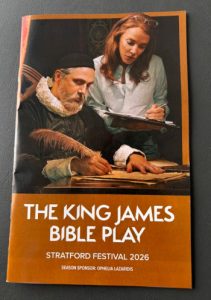
The King James Bible Play At The Stratford Festival
The awkwardly titled The King James Bible Play, by Charlotte Corbeil-Coleman, is a fascinating melange of ideas and notions of a distinctly feminist cast inspired by the work in the title. It is receiving a sprightly world premiere under the direction of Nina Lee Aquino at the Stratford Festival’s under-used Studio Theatre.
The “King James Version”, a.k.a. the “Authorized Version,” was commissioned by King James I in 1604. The project took seven years to complete.
In a programme note, the author describes the King James Bible as a new translation. That’s not quite true. It was, in fact, a largely editorial project that sought to reconcile inconsistencies among previous English bibles – the Geneva Bible, Coverdale’s Bible, Matthew’s Bible, going all the way back to William Tyndale’s first English translation (c. 1522-1535). New translation only occurred when specific words or phrases were deemed to be in need of revision or improvement.
So you see the things that you’re liable to read in the programme, they ain’t necessarily so.
The fact that the King James Bible cribbed so much from existing translations explains why it is full of ye’s, thee’s, thou’s, and begat’s, words that were already disappearing from the language spoken by contemporary Londoners. Those usages give the work a somewhat elevated tone that has made it the favourite of many readers beyond the Anglican faithful for whom it was intended.
Six teams strove to create the “Authorized Version,” working in isolation from one another in Westminster, Oxford, and Cambridge, each team tackling a different chunk of the Good Book. When their work was done, a group gathered in London’s Stationer’s Hall to hear the finished product read aloud, as scholars followed along in Latin, Greek, and Hebrew versions. Nits were picked and adjustments made.
The first act of The King James Bible Play imagines one team of biblical scholars wrestling with some particularly thorny problems in the library of Henry Savile (a forceful Cyrus Lane). Two of them, John Perrin (an amusingly shy Michael Spencer-Davis) and George Abbot (a very funny pontificating Rylan Wilkie) are rigidly doctrinaire. Savile and John Bois (former Shaw principal Gray Powell making his Stratford debut) are more rational. They are assisted as scribe by Savile’s son Willie (Steven Hao), who seems to be an invention of the playwright.
Willie excepted, these characters are all historical figures. Most were members of the so-called Second Oxford Company, tasked with working on the core books of the New Testament. Bois worked with a Cambridge group on the Apocrypha, but apparently he joined with the others in the final stages of tidying up the project. So Corbeil-Coleman has clearly done her homework and the frequent messages arriving from an impatient King James tell us that the final deadline is at hand.
There are plenty of laughs in this act, including references to Shakespeare and the scandalous nature of the theatre. This talented cast makes the most of the opportunities.
But there was serious work to be done. Did Mary’s child “spring” or “leap” in her womb? Did St Joseph accept Mary’s pregnancy because he was a “just” man? We learn that Savile’s wife was pregnant by another man when they married, so he clearly has some skin in this game.
The most controversial topic they deal with is the word “witch” as in “Thou shalt not suffer a witch to live” (Exodus 22:18). Abbot and Perrin think it’s absolutely the mot juste. Perrin claims to have actually seen one. When he was five. Across the street. Savile is not so sure, positing that “poisoner” might be a better translation.
It really didn’t matter, of course, since King James had a fixation about witches and witchcraft. Like present day election deniers, Savile and company had a compelling need to keep the king happy.
So “witch” it was, a word with a specifically feminine connotation that has haunted women ever since.
In Act Two, Corbeil-Coleman imagines an equally amusing bunch of feminist theatre creators under the direction of Martie (Deborah Hay). They are Roni (Liz Der), Annas (Angel Lo), Cath (Sara Topham), and Han (Vivien Endicott-Douglas), Martie’s daughter, a former actress now an academic stepping in for someone else.
They are attempting to create The King James Bible Play using the techniques of creative collaboration while fending off the concerns of a skittish board nervous about the subject matter.
At first they are women playing the men we saw in the first act, but before long they turn their attention to the women behind those men. After all, who knows better whether a foetus springs or leaps in the womb than a woman?
There are some quite amusing pokes at the foibles of actors and directors including some perfectly silly routines for “getting into the mood.” In one highlight, Topham gives a tour de force rendition of a diva in full meltdown mode.
But as in Act One, there is serious business at hand as well and not surprisingly much of it deals with the themes of misogyny engendered through the ages by the biblical treatment of women as witches.
Mother-child relationships also loom large. Mirroring the Savile family from Act One, Martie was pregnant when she married the man Han knew as her father. Hay and Endicott-Douglas are alternately incendiary and heartbreaking as this dynamic plays out.
The sets by Robin Fisher and the lighting by Michelle Ramsay make excellent use of the Studio Theatre’s intimate space, with terrific effects that end each act. Fisher’s first act costumes are quite nice as well.
The King James Bible Play in both its acts is a heady brew that puts a lot of powerful ideas into play. While I didn’t feel that Corbeil-Coleman ties it all up neatly, in the hands of a stellar cast and Aquino’s strong direction she provides plenty of fodder for after theatre discussion over a nice single malt. Or maybe port. Possibly a snifter of brandy. Not to worry, a group of scholars will figure out the perfect potable.
The King James Bible Play continues at the Stratford Festival through September 21, 2026. For more information and to purchase tickets, visit the Stratford Festival website.
For a complete index of reviews CLICK HERE.
Don’t miss another review or blog post! SUBSCRIBE HERE
