

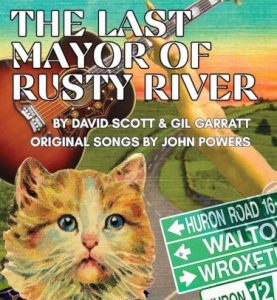
The Last Mayor Of Rusty River At The Blyth Festival
Small town politics receives the Blyth Festival treatment in the delightful The Last Mayor of Rusty River, a broad comedy by David Scott and Blyth Artistic Director Gil Garratt, with original songs by John Powers.
The action takes place in the council chambers of the small (and fictional) Huron county town of Rusty River, nicely designed and lit by Steve Lucas. When meetings are open to the public the audience fills that role nicely.
There we meet long-time mayor Larry Fletcher (Benedict Campbell) and his ally Jerry Jones (David Kirby) who represent the entrenched powers of Rusty River’s “old guard.” Fletcher has been in power for 32 years and has grown so comfortable in office that he thinks the messy, not to mention expensive, accoutrements of regular elections should be dispensed with in favour of appointing council members by acclamation.
Arrayed against them are two younger Rusty River councillors, Tim Macavity (Cameron Laurie) and Tina Stackhouse (Hallie Seline), owner of a trailer park or, as she prefers, a “tiny home community.”
Attempting to keep proceedings on an even keel is the long-suffering and frequently exasperated town clerk, Judy Townsend (Robin Craig). Documenting it all for what passes for Rusty River’s media is twenty-something go-getter Harmony Von Gasperkunkle (Brontae Hunter), whose surname and the mayor’s inability to remember it become a rich source of humour.
Macavity is all riled up by the mayor’s unwillingness to discuss serious business. Fletcher’s big project is to anoint a costumed red squirrel as Rusty River’s town mascot. For her part, Stackhouse wants to see serious action taken on the problem of homelessness, which not so incidentally is a growing problem in rural Ontario.
A mysterious $175,000 donation to build a kids’ splash pad reveals that Fletcher has made a sweetheart deal with the High Roller Beverage Co. of Las Vegas, Nevada, to build a bottling plant in Rusty River.
As it turns out, that plant will be located in a derelict but soon to be renovated old shoe factory owned by Mayor Fletcher.
Macavity and Stackhouse are incensed. Macavity’s frustration grows to such heights that rather than allow Fletcher an unopposed ninth term he gathers the signatures needed to run his 19-year-old cat, Captain Whiskers, for mayor.
And so the game is afoot. The second act is given over to Rusty River’s mayoral race, which attracts a surprise entrant. Ms. Von Gasperkunkel seizes the opportunity to reinvent herself as an Internet phenomenon with the website “Rusty Nation” on which she broadcasts the proceedings using her smartphone and a selfie stick.
When it comes to small town politics, playwright Scott clearly knows whereof he speaks. According to a programme note he was the last mayor of Seaforth (29 kilometers from Blyth). In an “amalgamation,” Seaforth joined other small communities in a new entity with the bureaucratic moniker Huron East. Garratt, I’m guessing, added much of the humour.
The humour is broad and plot twists somewhat predictable. It seems that not only are the public servants of Rusty River a rambunctious lot, but they have libidos to match.
Garratt also directs and does so with great gusto. He has encouraged his cast to give performances that reminded me of the heightened comedy style often seen in Saturday Night Live sketches or those Christopher Guest “mockumentaries.” Given the material it’s a wise choice.
Another canny choice is the use of Powers’ bluegrass-inflected songs. Turning straight plays into plays with music is becoming something of a Blyth stylistic marker. Every member of the cast plays a musical instrument, sometimes dropping out of character to head for the piano or grab a guitar.
The songs, which range from serviceable to quite amusing, act as a sort of Brechtian alienation device, reminding us that The Last Mayor of Rusty River is a broad political satire and not some Chekovian exploration of ennui in the provinces.
Power’s songs also have the the happy effect of turning the show into something of a house party, a common feature of rural Canadian culture. Thus The Last Mayor of Rusty River becomes not so much a night in the “the-aytur” but a homespun entertainment put on for friends and neighbours. Indeed, the show ends with the entire cast encouraging the audience to sing along to a song about “bitchin’ about the council.” They did a jolly good job of it, too.
The cast is very good, but best of all is Campbell as Mayor Fletcher. He’s an old pro with stints at Shaw and Stratford on his resume; as Mayor Fletcher himself would point out, experience counts. His fatuous windbaggery during the mayoral “debate” is a comic gem. Scott and Garratt have given him some of the best writing in the show here and he takes full advantage. When a member of the audience, warming to his implied role as a Rusty River citizen, spoke out against the Mayor, Campbell’s improvised response was priceless.
I also enjoyed the way Craig revealed the hidden, and rather surprising, depths of Rusty River’s town clerk.
Frankly, as an American, I found much of The Last Mayor of Rusty River puzzling. The idea that a politician would use his office to enrich himself is utterly alien to us Americans. But the raucous laughter of recognition all around me told me that this sort of thing happens all the time in Canada.
The audience reaction was so intense and so positive, in fact, that I could not shake the feeling that the audience saw in the play characters and events well known to them but not to me. Of course, they must be mistaken since The Last Mayor of Rusty River is fiction and any resemblance to real people or events is purely coincidental.
The Last Mayor Of Rusty River continues at the Blyth Festival through September 13, 2026. For more information and to purchase tickets, visit the Blyth Festival website.
For a complete index of reviews CLICK HERE.
Don’t miss another review or blog post! SUBSCRIBE HERE
[image] Beth Kates via Blyth Festival

