

Sisters of ’78 At The Blyth Festival
Sisters of ’78, the new play by Kristen Da Silva, now receiving its world premiere at the Blyth Festival, is a perfect example of what makes Blyth so special.
The play fulfills Blyth’s mandate to present new Canadian plays that reflect the lived experience of the people of Huron and nearby counties who make up the majority of its audience. It is also a deeply human portrait of a small community rent asunder, as well as a testament to the ways in which ordinary people can affect the tide of history.
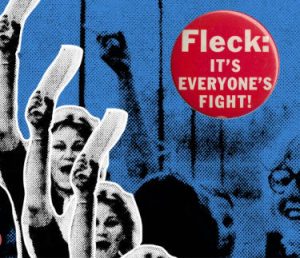
Sisters of ‘78 is a “ripped from the headlines” story of a five-week strike by women working at the Fleck Factory in rural Centralia, Ontario, just 33 miles from Blyth. These women churned out wiring assemblies for automobiles, in appalling conditions. Atrocious pay, substandard equipment, no safety protocols, regular injuries, some of them horrific, filthy washrooms, all served up with a healthy dose of sexual harassment.
The local doctor spent so much time patching up Fleck employees that he dubbed the place “The Butcher Shop.” It was a moniker that stuck.
The strike, waged in the bitter Canadian cold, was marked by police harassment, beatings, even imprisonment of strikers, not to mention political involvement that reached into the upper echelons of the federal government. The women persevered and the result, among other things, was the first codification of sexual harassment as a crime in Canadian labour law.
Da Silva’s impressive achievement in Sisters of ’78 is to take material that pretty much cries out to be turned into strident agit prop and create a deeply felt human portrait of the lives of the women who went on strike as well as those who didn’t. Although based on real events, all the characters in the play are fictional.
Her story centres around the struggles of Maeve (Madison Hayes-Crook), a stay-at-home mom trying to make ends meet with no help from her consummate schmuck of a husband, Andrew (Aiden Altow). He’s in the Royal Canadian Mounted Police, but he’s no Dudley Do-Right.
The one bright spot in her life is her Irish immigrant mother-in-law (Cara Hunter) who lends quiet support and the occasional dose of wisdom.
When Andrew goes off for an extended period of training, the financial strain compels Maeve to seek employment at Fleck, where her friend Laurie (Shaina Silver-Baird) works.
There we are introduced to the women who become the core of the strike, and a compelling bunch they are. Twenty-year old Angie (Shelayna Christante) is the unfortunate target of the sexual harassment of “Lumpy,” the supervisor (Geoffrey Pounsett). Sultry Natalie (Kirstyn Russelle) is a long-time employee with a wicked sense of humour and three kids at home. Another old timer is Joyce (Alyssa LeClair), who emerges as a powerful spokesperson for the strikers.
Many in the cast are making their Blyth debuts and director Mary Francis Moore has chosen them wisely. Hayes-Crook gives a sterling performance as Maeve. She carries the show. Her gradual development from cowed housefrau to frightened factory worker to ardent labour organizer and independent woman is beautifully crafted. I was reminded of those cinematic heroines of labour – Erin Brockovitch, Karen Silkwood, and Norma Rae – and the stars who portrayed them. Hayes-Crook is every bit their equal.
Christante, LeClair, and Russelle are all terrific. Da Silva and Moore have done a masterful job of delineating the growing bond between these women. Indeed, the strike itself is of almost secondary concern dramatically speaking. The real story is the growing solidarity among a group of working class women who change the course of Canadian labour history.
At a moment when everything seems to be going against them these downtrodden women burst into joyous dance. Sisterhood is, indeed, powerful.
Pounsett plays Lumpy without once overtly signalling his villainy. He’s the picture of the banality of evil and all the more disturbing for it. I’m assuming that director Moore deserves some of the credit for crafting this spot-on performance.
Altow has the unenviable task of portraying Andrew, the kind of unregenerate creep who gives male chauvinist piggery a bad name. Suffice it to say he rises to the challenge.
Brief mention should be made of the daughters of Maeve and Laurie. They are played by Goldie and Gloria Garratt, daughters of Blyth Artistic Director Gil Garratt. They are adorable.
Sean Mulcahy has created a suitably grim rendition of the Fleck sweatshop. A clever revolve stage left opens to reveal Maeve’s kitchen. He has also obviously consulted archival footage to provide period-perfect costumes for the cast.
The sound design of Lyon Smith is just perfect, laced with pop songs that take on a darker, sharper edge as the action proceeds.
Sisters of ’78 is powerful theatre. A rousing exhortation by LeClair that wraps up the strike elicited enthusiastic applause, as did several other moments during the show.
Adding special meaning to opening night was the presence of several women who had participated in that fateful strike nearly fifty years ago. Kudos to Garratt for asking them to stand and be recognized.
This is the sort of moment that binds a theatre to its audience. I wish there were more theatre companies that emulated Blyth’s approach to telling stories that resonate so deeply with their audience. Are there any?
Sisters of ’78 continues at the Blyth Festival through August 9, 2026. For more information and to purchase tickets visit the Blyth Festival website.
If you can’t make the Blyth production, you will get a second chance in the Fall when the show transfers to Theatre Aquarius in Hamilton, Ontario, where Moore is Artistic Director. Sisters of ’78 runs there from September 30 to October 17, 2026.
Footnote: If you would like to delve deeper into this fascinating bit of Canadian labour history – not to mention the rise of the feminist movement – there is an extensive “Study Guide” on the Blyth Festival site. You have to download it for the many links to become active.
On opening night a video monitor in the lobby was screening the short documentary, They Called It The Butcher Shop. If it is still there when you visit, take the time to watch it. It will give you a deeper appreciation of the care with which Blyth’s artists have recreated this seminal moment in Canadian history. A brief excerpt on YouTube is linked in the Study Guide.
[image: Blyth Festival]
For a complete index of reviews CLICK HERE.
Don’t miss another review or blog post! SUBSCRIBE HERE
