

Curveball At The Blyth Festival
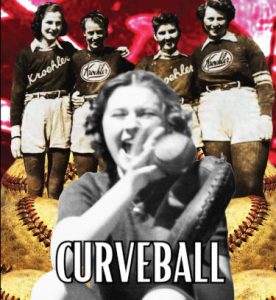
Following up on the success of Sisters of ’78, and with much the same cast, the Blyth Festival’s world premiere production of Curveball tells the story of Stratford’s Kroehler Girls. Like Sisters it is the tale of Canadian women struggling to make their mark in a world dominated by men who have an annoying way of frustrating their aspirations.
The Kroehler Girls were employees of the Kroehler (pronounced KRAY-lur) furniture factory, now defunct but once one of Stratford’s major employers. Their softball team became a regional powerhouse. But in 1953, when Curveball is set, the times they were a’changing.
Interest in women’s softball, which flourished during World War Two and boasted a professional league in the States, was beginning to wane. On top of that, an upstart Shakespearean Festival was erecting a huge tent nearby.
Curveball zeroes in on the women on the Kroehler Girls team, a colourful assortment that follows the time-honoured cliches of all those war movies where every platoon has one of each type.
Honey (Madison Hayes-Crook) is the team star. Wanda (Kirstyn Russelle) is the team sex pot who dares to aspire above the station to which the patriarchy has relegated her. Georgie (Shelayna Christante), her kid sister, is an enthusiastic newcomer with a powerful arm that belies her slender stature. The far more imposing Doll (Alyssa LeClair) developed her athletic abilities by dealing with three kids on top of her factory job. Rounding out the team are the abrasive Shack (Cara Hunter) – “Hey, boys, she’s still single!” – and Nora (Shaina Silver-Baird).
Curveball follows a fairly standard narrative arc common to sports stories in which a scrappy team suffers setbacks and self-doubt, seems on the verge of losing, and then (surprise, surprise) triumphs in the end.
What lifts Curveball above mere cliché are some fascinating elements, some historical and some purely theatrical.
Honey is the center of Curveball. A power hitter, who is key to the team getting to the playoffs, she not only suffers from the yips but is haunted – quite literally – by the memory of her older brother who died in the war. Her struggles and the empathetic help of her Coach (Geoffrey Pounsett), who lost his young daughter to scarlet fever, provide the emotional core of the show.
For many of the Kroehler Girls their love of the game and their hard-earned prowess spawned dreams of turning pro, something that for a brief moment in time seemed possible. Those hopes are dashed when, as attention shifts to male-dominated sports in the post-war era, opportunities for women evaporate.
Wanda, who has already risen from the factory floor to the steno pool, aspires to become Kroehler’s first salesman … er, salesperson. As she pleads her case to the head of sales, we can tell that she would do a bang-up job, especially since she has tellingly identified the lady of the house as the prime decision-maker in furniture purchases. The best the sales director can offer is a position as his private secretary. Well, why not? She is, after all, a looker.
Another touch that makes Curveball special is the introduction of the nascent Stratford Festival as an irritant to the Kroehler Girls. First of all, it becomes obvious, to the team members at least, that town and corporate monies that should rightfully have been used to provide them better uniforms are being siphoned off to support this theatrical interloper.
When Georgie meets James (Aiden Altow), an aspiring actor and supernumerary at the Festival, we have a veritable Montague-Capulet situation. And when James is sent to tell the team that they will have to alter their schedule so that their noisy games don’t discommode the great Alec Guinness, things only get worse.
This town/theatrical gown antagonism, by the way, continues to this day! But Georgie and James hit it off and the fretful passage of their star-crossed love is one of the sweetest things in Curveball.
Director Severn Thompson has done an excellent job of figuring out how a small cast can play dozens of roles. Remarkably enough it never gets confusing, even when Kroehler Girls have to play their opponents.
There are several standouts in the company. Hayes-Crook as Honey brings to Curveball the same air of leading lady assurance she displayed in Sisters of ’78. Christante is adorable as Georgie; she has a way of conveying the joys and agony of puppy love that melted my curmudgeonly heart. Pounsett is not only touching as Coach but he effectively handles other, subsidiary characters, some of them none too nice.
Curveball is something of a musical – not of the sort Thomas Nostradamus foresees in Something Rotten over at the Stratford Festival, replete with big production numbers and dance breaks, but something more homespun. Still, with original music by Canadian folk legend Dayna Manning attention must be paid.
Not only has Manning penned a baker’s dozen of new songs, she provides keyboard accompaniment throughout. She even steps forward to sing “Diamonds Are For Everyone” while strumming her guitar. (Musical direction was provided by the seemingly indefatigable George Meanwell, who has become something of a Blyth fixture.)
Manning has wisely composed numbers that are firmly in the folk idiom, straightforward melodies that can be handled by just about everyone. Truth be told, not everyone in the company boasts a Broadway calibre voice, but they harmonize beautifully.
Curveball is the product of something called “collective creation,” a developmental technique that has distinguished the Blyth Festival since its creation.
In this case the creative collective is comprised of Kelly Mcintosh, who not so coincidentally manages Stratford’s local history museum; Stacy Smith; and Andy Pogson. Director Thompson also shares writing credit.
Fun fact: Thomson is the daughter of Paul Thompson, one of the pioneers of collective creation in the early 1970s. Indeed it was his work that inspired the founding of the Blyth Festival.
The conveniently diamond-shaped Harvest stage lends itself beautifully to the set design of Sean Mulcahy, who also provided some very nice costumes including spiffy new uniforms.
Curveball offers up a cornucopia of elements that make Blyth productions such a joy to watch. It a fascinating story of not all that distant local history that must have resonance with many members. I wondered how many people in the audience were the children or grandchildren of Kroehler Girls.
In typical Blyth fashion, none of this history is viewed through those proverbial rose-coloured glasses. The very real struggles of these characters remind us of how much society has changed since 1953 and perhaps how much work remains to be done.
All of this is served up by an enthusiastic company of young, multi-talented actors. It no longer amazes me when a member of a Blyth company picks up a musical instrument and starts playing winningly. Nor do I marvel that one actor can play two, three, or four roles, some of them very brief, and make them all distinct and memorable.
Best of all, for my money, none of this is slick or glossy or self-consciously arty. There is an endearing homespun quality to the work done here.
As a bonus, we get to sing “Take Me Out To The Ballgame,” lustily cheer the Kroehler Girls, and enjoy it all on the bucolic Harvest Stage on the tree-fringed edges of the Blyth Fairground while the sun sets and the heat of the day gives way to balmy night. Pure magic.
Curveball continues at the Blyth Festival’s outdoor Harvest Stage through August 22, 2026. For more information and to purchase tickets, visit the Blyth Festival website.
Footnote: There is a fascinating backstory to Curveball, which I discovered thanks to the fascinating Study Guide for the show, prepared by the Blyth Festival’s Director of Education, Lisa Hood.
Curveball had its genesis in 2021, when three actors, using collective creation techniques, improvised their way to a one-hour show called Kroehler Girls. Those actors were McIntosh, Smith, and Pogson!
Playing all the parts, they premiered their work during the 2021 season of Here For Now Theatre. In that pandemic year, HFN was performing under a tent in the back yard of the Bruce Hotel on land that had been the ball field on which the Kroehler Girls played. The factory was next door, on the corner or Ontario and Romeo, on land now occupied by the Arden Park Hotel.
Kroehler Girls was a smashing success. Christopher Hoile’s glowing review is well worth reading.
[image: Blyth Festival]
For a complete index of reviews CLICK HERE.
Don’t miss another review or blog post! SUBSCRIBE HERE

