

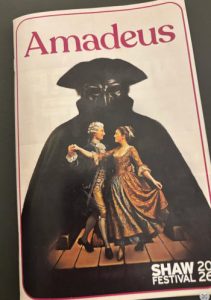
Amadeus At The Shaw Festival
Amadeus, the 1979 hit by Peter Shaffer, is receiving a workmanlike revival under the direction of Shaw’s Artistic Director Tim Carroll. One wonders why.
Amadeus tells the wildly ahistorical tale of the rivalry between Wolfgang Amadeus Mozart (Michael Therriault) and Antonio Salieri (Tom Rooney) in late eighteenth century Vienna.
Fun fact: Mozart’s actual middle name at birth was Theophilus (from the Greek, meaning “lover of God” or “loved by God”). Amadeus is the Latin equivalent, which he adopted. He also, from time to time, affected Gottlieb (German) and Amadeo or Amadè (Italian). Trotting out this trivia during the intermission is a great way to alienate your friends.
As Shaffer would have it, Salieri, a renowned composer in the court of Emperor Joseph II (a perfect Graeme Somerville), immediately recognized the younger man’s incredible genius, which he found immensely threatening.
Shaffer depicts Mozart as a randy, immature, potty-mouthed twit given to outbursts of the giggles. His Salieri is consumed with a jealousy that turns into a virulent hatred that in turn results in Salieri poisoning his rival. The historical record suggests otherwise, but let that be.
Indeed, Shaffer’s lasting accomplishment in Amadeus is that his depiction of these two men is now pretty much accepted as accurate by everyone except specialists.
I last saw Amadeus when Peter Hall’s revival made its obligatory stop on Broadway in 1999. I had my reservations about the script then, which Shaffer had streamlined since its debut twenty years earlier.
The current iteration is slimmer still, with Salieri’s wife having been done away with, either by Shaffer or Carroll. My reservations remain. In fact, they have grown stronger.
Amadeus was one of a veritable tsunami of highbrow English plays that washed across the Great White Way from the 1960s through the 1980s. They were witty, clever, well written, often with a patina of erudition and intellectual sophistication that left New Yorkers all aswoon. They were showered with Tonys. The 1980 Amadeus won five, along with two additional nominations.
In the cold light of the twenty-first century, in which having intellectual pretensions brands you as an enemy of the state, I’m not sure these plays, and Amadeus in particular, have aged all that well. Maybe it’s just me, who has most assuredly not aged well in the intervening years.
I now find Salieri’s (and Shaffer’s) insight that genius like Mozart’s rendered him, and by extension all of us, merely mediocre rather twee. Back in the day, as the expression has it, this was considered profound.
Moreover, the intellectual trappings of the play strike me as pro forma and a trifle threadbare. Shaffer’s invocation of the way Mozart’s operas reflected his life is fascinating only to the extent you are familiar with his oeuvre.
Thanks to the edjamacation I received from my opera-loving wife I could sorta follow along. I suspect that only a minority of the Shaw audience had even my pitiful level of familiarity. Unfortunately, although this production makes an effort, it cannot fill that gap with incidental snippets from Mozart’s works.
[Note To Self: Cue up Mozart’s greatest hits on Spotify.]
So I return to my opening query: why this revival? The answer is obvious: Shaffer, who let’s face it is a pretty good writer, blessed Amadeus with two central roles that actors queue up to play. Here the results are mixed.
At 48, Therriault is arguably too long in the tooth to play the twenty-something Mozart. An excellent actor and a Shaw stalwart, he seems condemned to give commendable performances in roles for which he is not ideally suited. Still, he more than earns the pathos of Mozart’s final moments.
Rooney is one of Canada’s greatest actors. Under Carroll’s less than attentive direction he falls short. Shaffer frames Amadeus as a memory play, narrated by the superannuated Salieri on the last day of his life.
In the 1999 Broadway production, David Suchet segued from decrepitude to robust health with consummate ease. I fancy that Ian McKellen, the original Salieri, did too. Rooney has the ability to do the same. Alas, in this Amadeus, director Carroll doesn’t seem to think that’s necessary. Too bad.
That same lack of directorial attention may be why Rooney’s performance, like that in Heartbreak House, seemed to be so one-note. Having seen his Uncle Vanya and Cyrano, I know he is capable of far more nuance.
Carroll has more success with the Venticelli or “little winds,” two stylized characters who represent both Salieri’s sources of societal intelligence and the pervasive culture of gossip that pervades the Vienna of the play.
Sochi Fried and Julia Course fill the roles beautifully. Costumed to resemble porcelain figurines, with rouged cheeks, stylized gestures, and precise choreography, they appear regularly to provide updates and help the story along. Their every appearance is sheer delight. I was a bit surprised that I didn’t see a credit for choreographer; David Andrew Reid is listed as movement captain.
Another winner in the cast is Kristi Frank as Constanze, Mozart’s wife. She progresses nicely from a perfectly adorable airhead to the long-suffering and devoted spouse of Mozart’s declining years.
Judith Bowden has provided beautifully detailed period costumes that show off to good effect on her stark and stylized modern set. Dominated above by what seems to be a reproduction of a snippet from a Mozart score, an upstage platform behind a scrim, and a horizontally raked platform downstage, the set presents some challenges for lighting designer Kevin Lamotte, who periodically overcomes them.
All things considered, this is not a bad rendition of Amadeus. The audience with whom I saw it certainly seemed to enjoy it. Yet I couldn’t shake the feeling that I was watching a twentieth century classic receding in the rear view mirror of theatre history.
Amadeus continues at the Shaw Festival through October 4, 2026. For more information and to purchase tickets, visit the Shaw Festival website.
Footnote: Coincidentally (or perhaps not) Shaw’s 2026 season also includes Sleuth by Peter Shaffer’s twin brother Anthony.
Footnote: In my review of the 1999 Broadway production I noted of “newcomer” Michael Sheen, “there’s an excellent chance he’ll become one of England’s finest actors.” Every once in a while I get one right.
For a complete index of reviews CLICK HERE.
Don’t miss another review or blog post! SUBSCRIBE HERE
